
Support · Care & studio · 16 min read
Why we invoice in Canadian dollars
Quotes, contracts, and checkout are CAD so nobody is doing exchange-rate theatre.

A Vancouver studio quotes in Canadian dollars
SYCGeeks is in Vancouver. Our people, our rent, our Square hardware, and the tax we remit on studio fees live in Canadian dollars. Proposals, the checkout catalog, care plans, and published add-ons are therefore in CAD. We do not publish a USD sticker and hope the exchange rate is kind on the day you pay. We do not quote “about five grand” on a call and invent the cents later. The number on the quote is the number on the checkout.
That choice is for you as much as it is for us. A Canadian operator comparing two studios should be able to put our page next to our invoice and see the same currency. Searchers who want a local studio already look for the city and the dollar. Hide CAD and you look like an offshore template farm that will surprise you at capture. We would rather look like what we are: a bilingual studio that invoices in the money you already bookkeep.
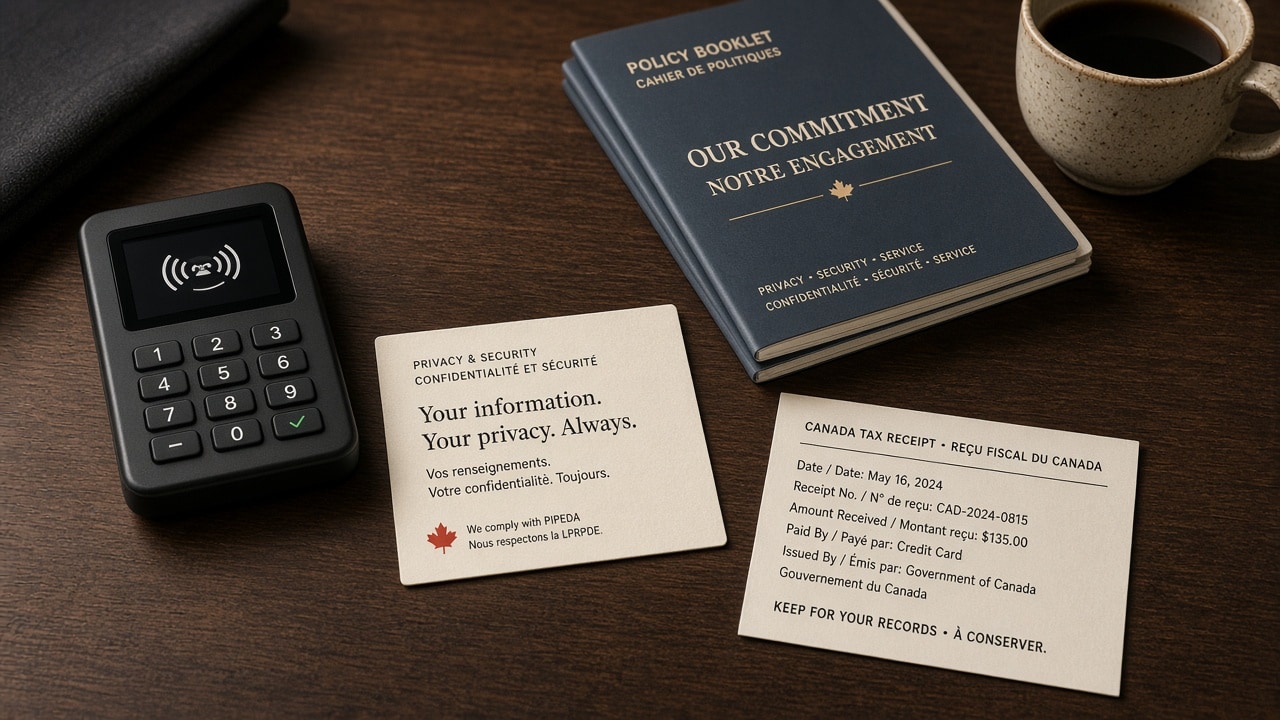
English and French receipts follow the same rule. If you bought both languages, the invoice and the payment receipt should be readable in both. A French receipt that is English with accents is a product bug, including when the product is our own checkout. If your board or your bookkeeper needs a PDF in French, put that in the project notes. We will not tell you to “just print the English one.” Official-language work includes the money surfaces.
Terms are governed by the laws of British Columbia. Disputes, if they ever happen, are resolved by arbitration in Vancouver unless we both agree otherwise. That is another reason the invoice is CAD. We are not going to argue about a number that moved overnight because a mid-market rate in New York had a mood. Write the number. Pay the number. If the number must change, write the next number.
If you are outside Canada, we still quote in CAD unless we agree otherwise in writing before work starts. You can pay from a foreign card or a PayPal account. The processor will do its conversion and take its fee. We will not do a second conversion on top and call it a “wire desk.” Ask for the CAD total, ask what the processor will add, and decide. Exchange-rate theatre is how international work goes sour.
The number you approve is the number you pay
A scoped quote in CAD lists what we will ship, what we will not, and how care works after launch. You approve that number before anyone writes production code. Checkout shows the same number. The receipt shows the same number. If GST or HST applies to our studio fees, it appears as tax on the invoice, not as a rounded surprise inside a USD price. The quote number is the pay number. That sentence is the whole billing product.
We do not start production on a handshake and a mood board. If the brief is still moving, we say so and wait. A messy brief is fine. An invisible one is not. Once you approve, we open the project in your dashboard, set the workflow, and book the first working session. You will always know the current step and the CAD amount already paid. Silent calendars and silent invoices are the same failure mode.
If scope changes, we write a new number. That is true during the first build and true after launch. An extra page, a language you did not buy, a checkout change, product stills, a new collection, or eight reserved hours are published add-ons with published CAD prices. Care members pay about 25 percent less. We do not finish the extra work and then mention it was “a bit more.” Silent overages are how trust dies.
You should be able to open the project six months later and match every receipt to a sentence in a quote or an add-on name. “Website — approved 12 March — $X CAD.” “Studio care · yearly — $4,500 CAD.” “Checkout change — care rate — $2,400 CAD.” If a line does not have that sentence, write admin@sycgeeks.ca the same day. We would rather correct a receipt than argue with a bookkeeper in November.
Wallet payments, when you choose them, still use a quoted CAD amount you sign. They are not a way to pay a different number because a token moved. Crypto or personal wallets are an extra rail on this site, useful for some clients and confusing for most. We treat them as an extra, with a signed quote and a confirmed transaction. The approved amount does not float with a chart.
How a typical project is billed
A typical build invoices 20 percent to start, 30 percent at design, 30 percent when core function works, and 20 percent at launch, all in CAD. The split exists so you are never paying the whole fee for a product you have not seen, and we are never financing six weeks of production on a handshake. Deposits cover discovery already done if either side ends the engagement in writing. You pay for work completed to that date.
“Core function works” means the conversion you bought can be finished by a stranger: a booking, a checkout, a lead, an appointment. It does not mean every taste note is closed. It does not mean a second marketplace you mentioned in week nine. If two conversions fight each other, we picked one for launch on the quote. The 30 percent at core is for that conversion. The last 20 percent is for content, bilingual review, the test order, and go-live.
A focused marketing site is usually six to ten weeks if copy and images arrive on time. Ecommerce, appointments, and custom APIs add weeks because they touch money and other people’s systems. Square, Stripe, or a warehouse feed will not be rushed into a Friday deploy because a campaign starts Monday. Content and approvals move the calendar more than code. Name one person who can approve. Invoice dates follow those approvals, not a fantasy Gantt.
Launch includes a support window for defects on what we shipped — 30 days in the terms, up to 90 on a denser bilingual or payments build. That window is not a fifth invoice. It is part of the launch fee. New ideas inside that window are still new scope. We will not take the last 20 percent and then treat a second language as a free defect. The companion guides on care and more work after launch exist so that argument is short.
Appointments are a separate catalog: discovery is complementary, a project review is $250 CAD for 60 minutes, a compliance consult is $350 CAD for 45 minutes, an AI or blockchain consult is $450 CAD for 60 minutes. Those invoices are also CAD, also the number on the page, also subject to processor fees. Book on Pacific time. Bring the facts you would put in an email. We will not spend the hour guessing the product and then send a larger invoice because the hour ran long.
Processor fees stay with Square, Stripe, or PayPal
Card and PayPal fees are the processor’s. We do not hide them in a USD sticker price and we do not mark them up as a studio “convenience.” When you pay us, Square, Stripe, or PayPal takes its Canadian fee on that charge. When your customers pay you, their processor takes its fee on those charges. Two different relationships. Two different receipts. Read the Canadian fee pages before you sign either one. Rates move. We will tell you which integration we can keep healthy after launch, not which logo looks newest.
Square is the honest choice when you already take cards at a counter. Appointments, POS, and a website can share one account. Hardware is the reason people stay. Stripe is usually better when subscriptions, usage, or a marketplace live inside a custom app. PayPal is what many Canadians already trust and a poor only processor for a custom product. We add it beside a card processor. Apple Pay belongs when the primary processor can settle it. We do not fake the button.
Your payouts are yours. We do not sit in the middle of your customer charges and we do not take a revenue share on jackets. Hosting watch under care means we can see whether the integration we built is still completing a real Canadian order, not whether your bank landed. If a webhook silently drops paid orders, that is an incident. If your processor holds a payout for their own risk review, that is a conversation with them. We will help you read the dashboard. We will not pretend we are the processor.
Test with a real CAD order, not a demo card in USD. Refund it. Read the receipt in both languages if you bought both. Tax lines, item names, and the dollar symbol have to be right. Care’s reserved hour and hosting watch exist so that test does not become a one-time ritual you forget in February. A theme that looks finished and a processor that stopped capturing CAD is how you sell a jacket twice on a Saturday.
If a processor fee on our invoice looks wrong — a currency conversion you did not expect, a duplicate capture, a receipt in the wrong language — write admin@sycgeeks.ca with the receipt ID and call +1 (672) 200-7924 on a weekday if money is stuck. Put the same facts in the project notes. The quote number should still match the pay number. The fee line should still belong to the processor. If it does not, we correct our side the same day we can see it.
International clients and conversion on the quote
We work with teams outside Canada. Toronto is not international. Berlin is. In both cases the default quote is CAD. If you need a USD or EUR figure for a board deck, we can put a converted estimate on the quote as a courtesy line, dated, with the rate we used that morning. The payable number remains CAD unless we signed a different currency before work starts. Courtesy lines expire. Payable numbers do not float.
Your bank or card network will convert. That conversion is not our invoice and not our margin. We will not “eat the spread” on a quiet month and “adjust” on a loud one. We will not reissue the quote because the dollar moved on Thursday. If the spread is a deal-breaker, say so before we start and we will either agree a written currency or decline the work. Declining is cheaper than a year of rate arguments.
Appointments stay on Pacific time from Vancouver. The overlap with Europe is the morning here and the afternoon there. The overlap with the east coast of North America is most of the working day. If the thing is on fire, call on a weekday. If you have a brief we can price, write. Geography is not a reason to switch the invoice to USD. It is a reason to be precise about who can approve while we are awake.
Taxes are a Canadian conversation even when you are not. If you are a GST/HST registrant buying studio services, say so and send the number. If you are a foreign company without a Canadian presence, say so. We are not your accountant. We will not invent a tax position on Slack. We will put the position we are using on the invoice so your side can accept or question it in writing before the charge.
International work still ships in the languages you bought. A US company selling into Quebec still needs a real French path if that is the brief. Bilingual work is not a toggle and it is not cheaper because the invoice is CAD. It changes IA, legal copy, and how we test. Pay for the language pass if you did not buy it at launch. Do not ask us to hide French behind a flag to save a line on the quote.
Care invoices and add-on line items
Monthly care is $450 CAD, billed each month as shown at checkout. Yearly care is $4,500 CAD on one invoice — two months included versus paying $5,400 CAD over twelve months. Both cover hosting watch, small copy and dependency updates, one reserved studio hour, and a note in your dashboard of what changed. Yearly also priority-schedules that hour. Neither invoice is an unlimited design bucket. Neither invoice absorbs a new collection.
You can add care at checkout with the project or attach it later from the launched record. The SKU you pay is the SKU you have. We do not auto-upgrade monthly into yearly when a campaign starts. We do not refund unused reserved hours. Unused time does not become a December bank. If you pause, watch and the hour stop at the end of the period you already paid. The project remains launched. Add-ons remain available at the standard rate.
Published add-ons are separate CAD lines on the same project: extra page $2,400 standard / $1,800 care; extra language $1,800 / $1,350; checkout change $3,200 / $2,400; product stills $1,200 / $900; new collection $2,800 / $2,100; eight reserved hours $1,600 / $1,200. You pay, we write the add-on into the dashboard, we set status from launched back to active, and we keep every old receipt. Care members see the lower number. That is about 25 percent, not a phone discount.
The reserved hour versus the add-on is a purpose test, not a stopwatch used against you. Restore what you bought — a French receipt, a dependency, a contrast fail — belongs in care. Change what you bought belongs on an add-on invoice. If a “small copy” request becomes a new information architecture, we stop and write the add-on name before we continue. We will finish our defect even if the hour is used. We will not finish your new homepage inside “care.”
Finance teams that want one CAD invoice for the year should buy yearly care and, if they already know a checkout change is coming, buy that add-on on the same project rather than hoping the hour will stretch. Hope is not a purchase order. The dashboard should show the care line and the add-on line as two sentences a controller can audit. If your controller cannot audit it, the note is not finished.
Receipts in English and French
Money surfaces are bilingual work when you bought both languages. Quotes, invoices, checkout labels, error states, and refund receipts must be correct, not decorative. “Dollars canadiens,” “$ CA,” tax names, and the date format a Canadian bookkeeper expects are part of the design. We test those surfaces before launch the same way we test a booking calendar. A checkout that fails in French is a Canadian product bug, including when the checkout is ours.
Ask for the language of the PDF in the project notes. Some boards want English only. Some Quebec teams want French only. Some federal-adjacent clients want both, every time. We will not guess. A machine dump with accents is not a French invoice. If a processor’s own receipt cannot be French, we say so on the quote and we still keep our studio invoice correct. Honesty about a vendor limit is better than a fake bilingual PDF.
Dates on our documents use a readable Canadian form, not an ambiguous numeral pile. Times that matter — a deploy, a refund, a care note — are Pacific time. If your team is in Halifax, do the conversion once and write it in the notes. Do not argue about “was that 2 p.m.?” six weeks later. The dashboard note after a care hour should be as precise as the invoice line: what changed, where, when.
Keep receipts on the project, not in a personal inbox. Staff change. The person who approved the first 20 percent may be gone at launch. The next operator should open the merchant dashboard and see status, progress, notes, and every CAD receipt without calling Vancouver. That is why we refuse to run billing as a Slack vibe. If you need a restated PDF, write. Do not screenshot a payment confirmation and call it the books.
If a French receipt is wrong after launch — tax label, language, missing refund — it is a defect. Report the URL, the language, and the receipt ID. Inside the 30–90 day window, that is launch support. After the window, it is the reserved care hour if you have care, and still our problem if the defect is clearly ours. A new invoice format you now prefer is new scope. We will say the bucket in one sentence.
No silent overages — write the next number
If a scope changes, we write a new number. We stop if the work is about to leave the thing you bought. That is uncomfortable when a campaign is Monday and the branch is already open. It is still correct. A half-finished tax rule shipped to make a date is worse than a Wednesday launch with a written change. We would rather decline a fantasy timeline than miss a real one, including the timeline of an invoice your board already approved.
Silent overages show up as “we will just keep going” and as a larger capture you did not click. We do neither. The checkout catalog exists so the next amount is visible before it is payable. Care exists so small restore work does not need a new quote every Tuesday. Add-ons exist so medium change work has a published CAD price. New products get a new quote. Handshake scope is how studios go quiet and invoices go strange.
Yearly care at $4,500 CAD does not buy a floating week of new pages. It buys watch, small updates, a reserved hour each month, priority scheduling, and the care rate on add-ons. If you feel you already “paid for flexibility,” read the care guide again. Flexibility is the published menu plus a sentence about the bucket. Flexibility is not an informal tab we mention in June.
PIPEDA still applies to billing data. Invoices, receipts, and card metadata are personal information when they identify a person. We do not paste full card numbers into project notes. We do not leave a finance PDF in a public ticket. Access and correction requests that mention an invoice go to admin@sycgeeks.ca. We keep what we need to show you paid, not a second CRM of health details somebody pasted under a receipt.
Three doors remain when money is the question. Write admin@sycgeeks.ca with the quote, the receipt ID, and the number you think is wrong. Call +1 (672) 200-7924 on a weekday if a capture is stuck or a launch is today. Book a Square appointment on Pacific time if you want to talk through a new CAD number before you approve it. Bring the same facts you would put in an email. We are a Vancouver studio. We invoice in Canadian dollars. The number you approve is the number you pay.