

Support · Payments · 12 min read
Choosing Square, Stripe, or PayPal in Canada
Hardware, subscriptions, and brand control point to different processors.
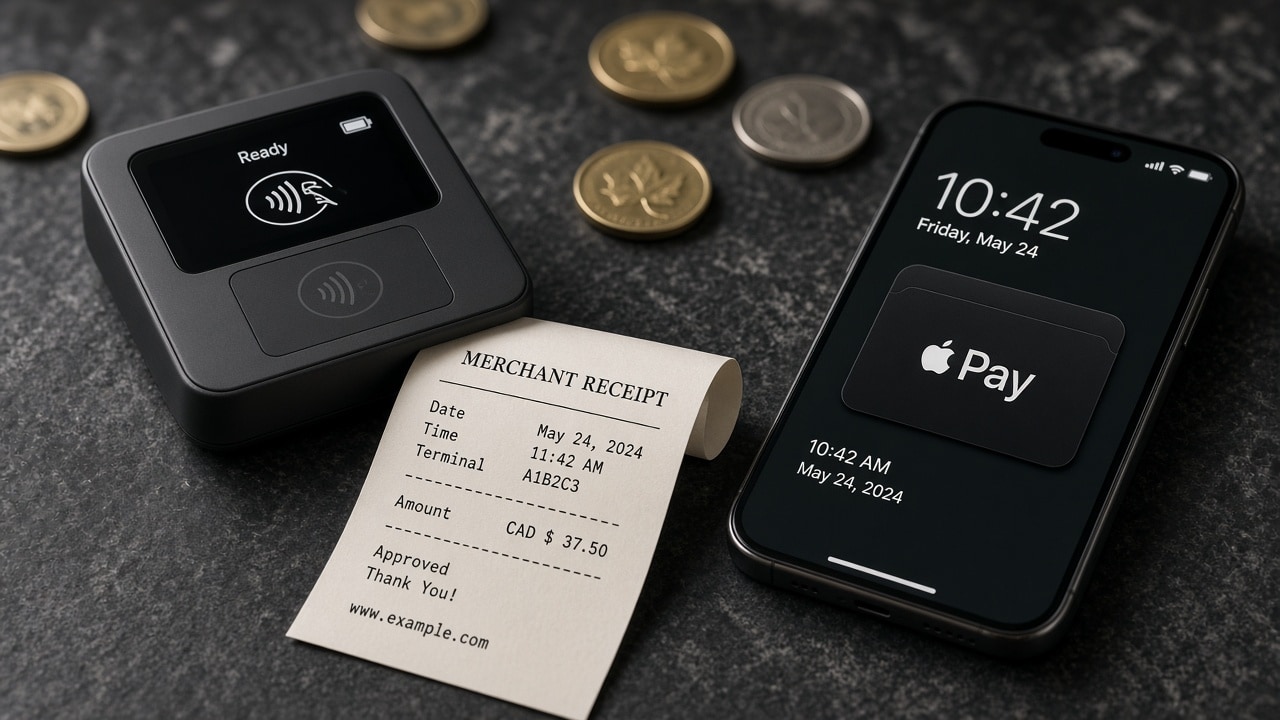
Hardware, subscriptions, and who owns the brand at pay.
Square, Stripe, and PayPal all take Canadian cards. That sentence is where most comparison blogs stop, and it is not enough to pick a processor. Hardware, subscriptions, and brand control point to different companies. If you already take cards at a counter in Vancouver, Square is the honest choice because the terminal, the appointments calendar, and the website can share one account. If checkout lives inside a custom Next.js or mobile app — memberships, usage, a marketplace — Stripe is usually better. PayPal is what many Canadians already trust; it is a poor only processor for a product you want to look like yours.
SYCGeeks is a Vancouver studio. We quote in CAD. We settle our own checkout through Square, PayPal, Apple Pay when Safari and the device allow it, Interac e-Transfer with a match key, and optional ETH quoted from Uniswap and converted to CAD. We use those rails because they match how Canadian clients actually pay us. We will not copy the whole set onto your store because it looks complete. Your catalogue, your room, and your staff decide the primary processor. Everything else is an extra we add when it earns the button.
Read the Canadian fee pages before you sign. Rates move. Cross-border cards cost more than domestic cards. Interac debit is not the same product as Interac e-Transfer. Apple Pay is not a processor; it is a wallet sitting on Square or Stripe. GST/HST is not a processor either; it is a tax line you configure before anyone picks a theme. We will tell you which integration we can keep healthy after launch, not which logo looks newest. Care is $450 CAD a month or $4,500 CAD a year. Watching the jobs that move money is part of that hour.
PIPEDA still applies. A processor holds personal information: names, emails, last-four, sometimes a shipping address. Your privacy page should name Square, Stripe, or PayPal — not “our payment partners.” If you add a chatbot that sees the cart, that is still personal information. We do not drop a tracker because a template did. Collect only what you will use to finish the sale or fulfill it.
Square when you sell in a room and online.
Square is the honest choice when you already take cards at a counter. Appointments, POS, and a website can share one account. Hardware is the reason people stay. A terminal that prints a CAD receipt, a staff app that can refund without calling us, and a calendar that takes a deposit for a Saturday slot are one product. If you cut hair, see patients, run a showroom, or sell jackets on Granville, starting with a second processor “for the website” is how you split inventory and double-sell a SKU.
We use Square for studio appointments because hardware, payments, and the calendar can live together. Discovery is 45 minutes and complementary. A project review is $250 CAD. A compliance consult is $350 CAD. An AI consult is $450 CAD. Bookings run on Pacific time from Vancouver, with buffers so a 45-minute conversation does not collide with the next one. The same idea applies to your services: name them the way a client would, put duration and CAD price beside the name, and make the booking appear in a dashboard, not only in email.
Online, Square can settle cards and Apple Pay in CAD when the account is a Canadian account. That is the test: a real CAD order, refunded, receipt read in English and French. A US Square sandbox is not a Canadian store. If you sell in person, POS inventory must be the same truth the website reads. We would rather wire Square to Shopify or to a custom storefront than invent a spreadsheet that is “source of truth until we sync.” Saturday in Vancouver will find the crack.
Square is a weaker fit when your product is a subscription billed on a custom schedule, a marketplace with many sellers, or an API that needs Stripe-shaped webhooks and customer objects. We will say so. We will not stretch Square into a billing engine it is not. That stretch is how launches slip and how refunds become a Tuesday forensic. If you need both a counter and subscriptions, we will name a primary and a secondary, not pretend one dashboard does everything.
Stripe when checkout lives in a custom app.
Stripe is usually better when subscriptions, usage, or a marketplace live inside a custom Next.js or mobile app. You will spend more engineering time. You get APIs that behave. Customer objects, invoices, metered billing, and webhooks you can retry in the open are the reason. If your operators should not wait on a developer to change a price, this may still be the wrong primary — Shopify plus Stripe, or Square at the till, might serve them better. Stripe is a processor for products that are software.
Canadian Stripe accounts settle in CAD. Use one. A US account with a currency toggle is how receipts print USD and how GST looks like an afterthought. We configure tax to the provinces you actually sell into, then we test a real CAD invoice, including a failed card and a refund. Subscriptions must show the tax story on the first receipt and on the tenth. If French is in scope, invoices and dunning emails are rewritten, not squeezed. “Your card was declined” and “Votre carte a été refusée” are both launch copy.
Apple Pay on Stripe still needs a verified domain, Safari, and a configured device. We will not fake the button in Chrome on Windows. Google Pay can sit beside it when it is supported. Cards stay. PayPal, if you want the familiar extra, is a second integration, not a Stripe feature you get for free. Optional ETH is outside Stripe on our studio checkout; if you want crypto on your product, it is a signed quote and a confirmed transaction, never the only path for a subscriber who just wants to stay billed.
Webhooks need retries you can see. After launch, the dangerous part is silent failure: a paid invoice that never marked the membership active, a refund that never cleared the seat. We treat the API like a product — versioned routes, predictable errors, a page a future developer can read without calling us. Care includes watching those jobs. If a webhook fails on a weekday, call +1 (672) 200-7924. If you want a new billing rule, that is a checkout-change add-on on the same project, about 25 percent less with care.
PayPal as a familiar extra, not the only rail.
PayPal is what many Canadians already trust. It is a poor only processor for a custom product: the brand and the return path are less yours. Shoppers leave your checkout, land on a PayPal page that does not speak your type, and come back — sometimes. We add it beside a card processor so the person who will not type a card number can still finish. We do not build a custom app whose only money path is PayPal. Chargebacks, subscriptions, and Apple Pay all get harder when PayPal is the house.
If your customers are small Canadian firms that already pay vendors through PayPal, the extra button is kindness, not decoration. Put it second or third, after Apple Pay and cards, unless your audience data says otherwise. Test a real CAD PayPal order, refund it, and read whether the receipt still looks like your store. If the only record is a PayPal email in English, and your site is bilingual, we are not done.
PayPal fees are PayPal’s. We do not hide them in a USD sticker price. If you are tempted to add PayPal, Square, Stripe, Apple Pay, Google Pay, Interac, and ETH on day one, stop. Each extra rail is an extra failure mode, an extra refund path, and an extra privacy mention. Pick a primary. Add one familiar extra. Add wallets the primary already supports. Leave crypto off the consumer catalogue unless you have buyers who asked for it in writing.
PayPal as a login for your own dashboard is a different product from PayPal as a pay button. We do not use PayPal to create studio accounts. Merchants register with email or a wallet, pick a role, and land in the matching dashboard. Do not bury a new processor inside an old project’s notes. If you want to add PayPal after launch, that is a published checkout change on the same project.
Interac e-Transfer needs a match key, not a screenshot.
Interac e-Transfer is how a lot of Canadian firms still prefer to pay a studio invoice. It is not the same as Interac debit at a terminal. On our checkout we email a confirmation number and a match key — SYCG- followed by six characters from an alphabet that avoids look-alikes. The buyer puts that exact key in the Interac message. The purchase sits in awaiting until we match the key. Then the project opens on the account. A screenshot of a banking app is not a match. “I sent it” without a key is not a match.
If your store will offer e-Transfer to shoppers, copy that discipline. Unique key, waiting status, human or automated match, then fulfillment. Do not publish a generic email on the shipping page and hope. Money will land with a memo like “order” on a Friday night and nobody will know which cart it belongs to. Keys must be unique. We allocate them so two purchases cannot share one. Your system should too.
e-Transfer is slow compared with a card. Say so. Do not promise same-day shipping on an Interac order you have not matched. Dashboard status should show awaiting, sent, and paid in language a merchant can read. Studio staff match keys from the purchases screen; that is not a customer self-serve button. If you are the merchant buying from us, you will see the key on checkout and in email. Put it in the Interac message. That is the whole instruction.
GST/HST still applies on an Interac sale. The receipt you send after the match should show the same tax line a card receipt would. Currency is CAD. If someone e-Transfers USD by mistake, that is a support problem, not a silent discount. We will not mark an Interac paid because the dollar amount looks close. Close is how books drift.
Wallets and optional ETH sit on top of a real processor.
Apple Pay is the wallet most Canadian shoppers already have. It belongs on a phone checkout when Square or Stripe can settle it. It will not appear in every browser, and we will not fake the button. Google Pay follows the same rule: supported, or absent. A painted logo is how you train people to tap a dead control and blame your store. Always keep a card path for people who just want to buy.
Crypto or personal wallets are a first-class rail on this studio site when you choose them — useful for some clients, confusing for most shoppers. We treat them as an extra, with a signed quote and a confirmed transaction. ETH is quoted from the Uniswap v3 USDC/WETH pool, converted to CAD. If the live quote is unavailable, checkout says so rather than inventing a number. Crypto is never the only way to pay a Canadian store, and it is never the way we collect GST for a stranger buying a hoodie.
Wallet login to a dashboard is not wallet checkout. Signing a message to enter as a merchant is a different flow from sending ETH to a studio address. If wallet login fails, it is usually the database or a blank server response — not the customer’s fault. We return readable errors. You should too. Do not reuse an Apple Pay button as a login. Do not reuse a MetaMask connect as a pay button without a quoted CAD amount on screen.
If you want wallets on a product we build, say which ones in the brief. We will map each to a processor or to an on-chain quote, test it on a real device, and keep the card path. Adding a wallet after launch is a checkout change: $3,200 CAD standard, $2,400 CAD on care, two to three weeks, on the same project. We will not silently fold it into the reserved hour.
Fees, tax, and what we can keep healthy.
Processors take their Canadian fee. We do not hide it. Your accountant still needs a GST/HST story that is not “whatever the plugin did.” Decide tax before theme. Name provinces shipped. Place a real CAD test order on the primary rail, then on each extra you insist on shipping. Refund them. Read the receipts. If a French receipt is English with accents, we are not done. If settlement is USD, we are not done.
After launch, care watches the processor. Monthly is $450 CAD. Yearly is $4,500 CAD — two months included. Both cover hosting watch, small copy and dependency updates, one reserved studio hour, and a note in your dashboard of what changed. A new rail, a new tax rule, or a subscription plan you did not buy is a published add-on. Care members pay about 25 percent less. The project stays the same record. We do not ask you to onboard with a stranger.
If production is down — checkout failing, webhooks silent, Apple Pay missing after an update — call +1 (672) 200-7924 on a weekday, Pacific time. That line is for heat. If you have a brief for a new processor, write admin@sycgeeks.ca with the systems you already pay for, the conversion that matters, and the date. If you would rather speak, book a Square appointment. Bring the same facts you would put in an email. We will not spend the hour guessing the product.
The recommendation, said plainly: Square if you sell in a room and online. Stripe if checkout lives inside a custom app. PayPal as a familiar extra, rarely as the only rail. Apple Pay on the primary when it is real. Interac with match keys if you will take e-Transfer. Crypto never the only path. Tax before theme. A real CAD test order before anyone announces you are open. That is how we would choose if the Saturday till were ours.